Starting from zero is a gift because it hands you something that comfort never can: the chance to build a self you actually chose. I did not always believe that. For a long season I stared at the open space where my skills, my confidence, and my proof could one day stand, and I called it empty. But the openness was never a curse. It was an open field, and I was standing in the middle of it with seeds in my pocket that I had not yet learned to plant.
Everything I became started on the day I stopped waiting for someone to hand me a direction and started drawing my own with every small, silent action I took. That shift from waiting to building is the heartbeat of every word that follows, and I want to walk you through exactly how it happened, because I know there are countless people standing in that same field right now, seeds in hand, wondering if the ground is too bare to grow anything at all.
The Year I Wasted Waiting for Something to Happen
There was a stretch of my life I cannot mark with a specific date, only with the weight of stillness. I wanted things to change. I wanted to speak another language, to become someone capable, to feel the pride of building something from an open beginning. But I waited. I told myself the right moment would arrive, the right person would notice me, the right door would swing open if I just stood in front of it long enough. A full cycle of seasons passed, and when I looked back, only one thing had shifted: I was older. Nothing else. The waiting had produced nothing but time spent, and time spent without purpose is the only real loss I have ever known.
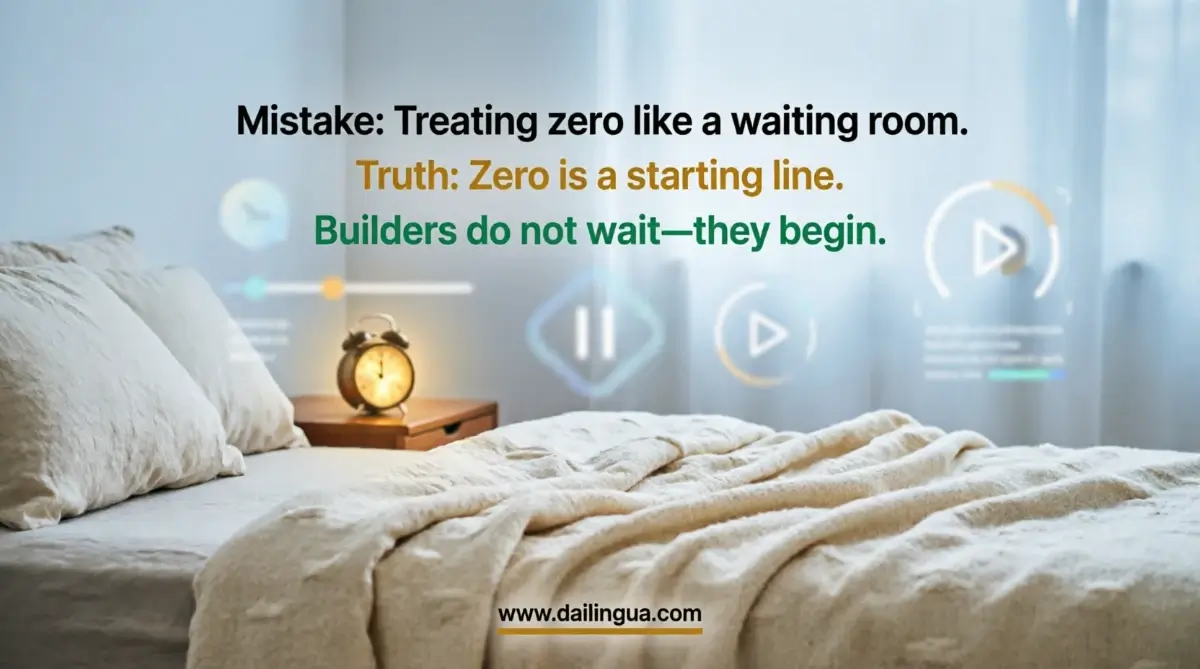
That awareness landed with a clarity I could not ignore. Not as a dramatic breakdown, but as a cold, clear fact that settled into my bones. I had been treating zero like a waiting room, a temporary condition that would resolve itself if I stayed patient. But zero is not a waiting room. It is a starting line, and the only person who can step forward is the one standing on it. When I finally understood that, I put down the old story I had been telling myself the one where I was not ready, not equipped, not enough and I picked up a new one. In that new story, I was the builder. And builders do not wait they begin.
I started with one single action. Not a grand gesture. Not a public declaration. I sat down at my small table in the early darkness and I wrote a single sentence in a language I did not yet know. The sentence was fresh, the letters leaned like young plants toward light. But I had taken an action that had no audience, no applause, and no immediate reward. That action was the first brick. If I had known then what I know now, I would have recognized that moment as the exact point where the gift of zero revealed itself the moment I learned that starting from nothing gives you an advantage no classroom can teach.
The shift did not feel dramatic from the outside. My life looked the same for a long while. But inside, something had shifted permanently. I had stopped being a person who waited and started being a person who moved. And movement, even the smallest kind, creates a different future than stillness ever can. I began to see the world in terms of small actions. A single phrase written in a notebook was not just ink on paper; it was evidence that I had chosen to build. The calm hour before dawn was no longer an empty stretch to endure; it was a gift of uninterrupted time that I could spend however I chose. The very landscape of my day transformed, not because anything external changed, but because I had changed the lens through which I saw it.
Why I Had to Become a Different Person
Here is a truth that took me a long time to accept you cannot stay the same person and expect a different life. The person I was before I started the one who spent evenings in loud places with friends who had no interest in growth, the one who woke up late and drifted through days without direction that person was not capable of building anything from zero. I had to let him go.
I changed my habits first I started waking before the sun, not because it was effortless, but because the early hours held a stillness I could shape into practice. The first week my body resisted. The alarm would sound and I would lie there, the warmth of the blanket pulling against the promise I had made to myself. But I got up anyway. I splashed cold water on my face and sat at my table, the single lamp casting a pool of light on the notebook. Those early mornings were not glamorous. They were cold and dark and often lonely. But they were mine. And in that ownership, I found a kind of power I had never tasted before.
I stopped filling my evenings with noise and started filling them with study, with speaking drills, with the slow repetition of sounds that felt unfamiliar in my mouth the first time I tried to pronounce a phrase that required sounds my native language never used, my tongue stumbled and my throat tightened. I felt the heat of self‑consciousness rise in my cheeks. But I did not stop. I repeated the sound ten times, twenty times, until the muscles began to cooperate.
I began carrying a folded notebook everywhere, and instead of scrolling on my phone during open moments, I reviewed vocabulary I had written by hand. The act of writing the physical motion of pen on paper helped the words sink in deeper than any digital flashcard ever had. These were not sacrifices. They were trades. I traded comfort for growth, familiarity for forward motion, and the approval of others for the slow‑building respect I was learning to give myself.
The people around me noticed the shift. Some of them did not welcome it. Friends I had known for years began to drift away, not because I pushed them, but because I no longer fit into the spaces we used to share. I remember a particular evening when a group of old friends invited me out to the same place we always went. I declined, not out of pride, but because I had a speaking practice session scheduled that I did not want to miss. The texts that followed were a mix of confusion and subtle mockery.
“You’re always busy now.” “You think you’re better than us?” The words stung. I would be dishonest if I said they did not. But I had made a choice, and that choice was to become a different person. The old me would have folded under that pressure, would have gone out and laughed and pushed the practice to another day. The new me held the discomfort, acknowledged it, and sat down at the table anyway. The price of starting from zero is not what you leave behind; it is what you stop pretending you need.
I also learned that the most important actions are the ones taken when no one is watching. I practiced speaking alone in an empty room, my voice the only sound, my mistakes witnessed by no one but me. I recorded myself and listened back, noticing every mispronounced syllable, then doing it again. Those silent hours were the foundation of everything that came later. I was not performing. I was not trying to prove anything to anyone. I was simply building, one repetition at a time, and the absence of an audience made the work pure to stop relying on motivation and build discipline that lasts was born in those solitary mornings when I had to rely on nothing but my own decision to keep showing up this principle of deliberate life realignment to get your life back on track when it feels off course.
The transformation did not happen overnight there were days when the old habits called to me like a familiar song. I would catch myself reaching for my phone to scroll through meaningless content, or lingering in bed when the alarm had already sounded. But each time I noticed the pull and chose the new behavior anyway, I was building a new identity. The brain is a pattern‑making machine, and every repetition of a new action is a vote cast for the person you are becoming. Over time, the new identity stopped feeling like a costume and started feeling like skin. I was no longer pretending to be disciplined; I was becoming disciplined. And the discipline was not a punishment it was the scaffolding that held up the life I was building.
The Proof My Mind Needed Before It Would Believe
The greatest challenge I faced when I started from zero was not the absence of money or the absence of a teacher. It was the absence of proof. My mind had a persistent voice, and it kept repeating the same message: You cannot do this. You have never done anything like this before. There is no evidence that you are capable. That voice was convincing because it was technically correct. I had no track record. I had no certificate. I had no external validation that said I could learn a language on my own.
So I made the proof. I decided that my first language would be my evidence. I poured every available hour into it. I listened until my ears grew tired, I spoke until my throat felt raw, I wrote until my hand ached. I treated that first language not as a goal but as a test case. If I could learn one, I would have the proof my mind demanded. And when I did when I held my first real conversation without freezing, when I understood a full sentence spoken at natural speed without translating it in my head the voice of doubt lost its main argument. I had done it. The proof existed. And once my mind had that proof, it stopped resisting and started cooperating.
A lesson I return to often is this the brain prefers the familiar path. It will always choose comfort over effort if given the option. But when you remove the familiar option when you commit so fully that there is no exit door the brain adapts. It finds a way to do the hard thing. And once it gets used to doing the hard thing, the hard thing stops feeling hard. It just becomes what you do this is the very heart of why adults can learn multiple languages when they stop treating learning like a school subject.
I remember the exact moment the proof became undeniable. I was sitting on a park bench, the afternoon light filtering through the leaves, and a stranger approached me to ask for directions. The question was in the language I had been studying. Without thinking, without translating in my head, I opened my mouth and answered. The words came out smoothly, naturally, as if they had been waiting there all along the stranger nodded, thanked me, and walked away.
I sat there for a long moment the weight of what had just happened settling over me. I had not prepared for that conversation. I had not rehearsed it. But the thousands of hours of silent practice had built something inside me that was ready when the moment arrived. That is the power of proof built in private. It does not announce itself until it is needed, and then it steps forward without hesitation.
From that point forward, learning additional languages became dramatically easier. Not because the languages themselves were simpler, but because my brain had a template for the process. It knew what to expect. It knew that the initial confusion was not a signal of failure it was a signal that growth was happening. The first language taught me how to learn, and that meta‑skill was more valuable than any specific vocabulary list or grammar rule. I carried that meta‑skill into every subsequent challenge, and it served me well that learning multiple languages from scratch was paved with the proof I built in those early, silent hours.
The People I Left Behind and the Strategic Space I Chose
One of the most important choices a person can make when starting from zero is to create distance from people who want to remain at zero forever. I learned this through direct experience. In the early months of my transformation, I still spent time with people who had no interest in growth. They were not bad people. But their comfort with stillness was a current I had to swim against. Every hour I spent in their company was an hour I spent drifting back toward the person I was leaving behind.
I made a deliberate decision I stepped away. Not with anger or judgment, but with the calm recognition that my future required a different environment. I started spending more time alone, and I called that choice what it was: strategic space. It was not loneliness. It was intentional removal of noise. When I deleted the distractions the endless conversations that went nowhere, the invitations that pulled me away from practice, the social obligations that filled my hours with emptiness I found something I had never experienced before. I found myself. I could hear my own thoughts. I could feel my own progress. I could sense the person I was becoming, and I respected him.
That strategic space became my laboratory. Inside it, I experimented with different ways of learning, different daily schedules, different methods of practice. I tracked what worked and set aside what did not. I became the architect of my own growth. And because I was alone, I was free from comparison. I was not measuring myself against anyone else’s timeline or anyone else’s results. I was simply becoming, in my own way, at my own pace. The clarity I gained in that space is the clarity to stop comparing your language learning progress to others.
The solitude taught me something else, something I did not expect. It taught me that being alone is not the same as being isolated. In the calm hours, I built a relationship with myself that had never existed before. I learned to enjoy my own company. I learned to trust my own judgment. I learned that I could sit with difficult emotions the sting of lost friendships, the frustration of slow progress, the fear of the unknown without needing someone else to rescue me from them. That emotional self‑reliance became a pillar of strength that has supported me in every area of my life since. The strategic space was not just about removing negative influences; it was about learning to be my own source of encouragement, my own cheerleader, my own proof that I could keep going even when no one else was watching the inner peace to stay mentally steady when everything falls apart.
How Silent Work Becomes Visible Proof
There is a rhythm to building from zero that most people do not understand until they live it. The work starts in total silence. No one sees it. No one applauds it. No one even knows it is happening. For weeks, for months, you show up every day and you do the thing, and the world outside remains completely indifferent. That silence can feel like nothing is happening. It is not. It is incubation.
I kept going through that silent stretch because I had made a promise to myself that the work was not dependent on recognition. I practiced speaking into a voice memo app every single day for months. I filled notebooks with sentences I could barely read a week later. I listened to the same audio clips so many times that I could hear them in my sleep. And then, slowly, almost imperceptibly, something shifted. The words started coming faster. The sentences started flowing. The language stopped feeling like a foreign object and started feeling like a room I could walk into.
When the right moment came when I finally spoke to a native speaker and held a real conversation the performance looked natural. It looked like talent. But it was not talent. It was the public result of private work, the visible tip of a mountain that had been built underwater, one stone at a time, in complete silence. What you do when no one is watching will eventually walk onto the stage, and when it does, it will not need an introduction. That is the gift of starting from zero. You build from such a deep foundation that by the time anyone notices, you are already steady the calm accumulation to learn sentence patterns that make you speak without thinking.
I want to emphasize that the silent phase is not a delay or a detour. It is the essential, irreplaceable part of the process. In a world that celebrates instant results and viral moments, the slow, invisible work can feel like failure. But every single person who has ever built something lasting whether a language, a skill, a career, or a character has spent countless hours in the silent phase. The seed that grows underground does not look like much from the surface. But without that underground growth, nothing can bloom. The silence is not emptiness. It is the sound of roots taking hold.
The Legacy Question That Zero Asks You
When you start from zero, you have nothing to protect no reputation to maintain. No past successes to live up to. No image to preserve. That openness is not a void. It is freedom. It lets you ask questions that people who are already established rarely get to ask. What do I actually want? What am I going to serve? What am I going to build that will outlast me?
I sat with those questions for a long time they were unfamiliar at first because I had no answers. But the unfamiliarity of not knowing is the birthplace of genuine purpose. I began to write down my thoughts in a notebook with a cover that had traveled with me through many moves not as a plan, but as an exploration. What kind of person did I want to become? What skills did I want to carry? What mark did I want to leave on the people who crossed my path? The answers did not come all at once. They emerged gradually, shaped by the daily practice of showing up and doing the work.
Another outcome of starting from nothing is the clarity it forces. When you have an open field, you can see exactly what matters. The distractions fall away. The false goals dissolve the ambitions that came from other people’s expectations the things you thought you wanted because someone else told you to want them lose their hold. You are left with the bare, honest truth of what you genuinely care about. And from that truth, you can build a life that is entirely your own. Not a copy of someone else’s. Not a performance for an audience. But a genuine, self‑authored existence. This process of uncovering your true direction mirrors the journey to find purpose in your language journey when you feel lost.
The legacy question was the hardest one. I remember sitting with it late one night, the room dark except for the single lamp on my table. What am I going to leave behind? The question felt too big, too heavy for someone who was still building the foundations of their own life. But I kept asking it anyway, and over time the answer began to form. I wanted to leave behind something useful. Something that would help other people who were standing at zero, wondering if they could build anything at all. I wanted to be proof that starting from nothing was not a disadvantage it was the starting point of something real and lasting. That desire eventually became the blog you are reading now, the hours of writing and sharing that I do every morning before the sun rises. The legacy I am building is not a monument; it is a trail of breadcrumbs for anyone walking the same path I walked.
That clarity is what I now recognize as the greatest gift zero ever gave me. It removed everything that was not mine every expectation, every comparison, every definition of success I had received from outside and left me standing in an open field with nothing but my own two hands and the freedom to decide what to build. If I had started with more, I might have built something safe and familiar. Starting from an open field forced me to build something true. And the difference between those two outcomes means everything.
What I Would Share With the Person Standing at Zero Right Now
If you are reading this and you are standing at zero no skills, no proof, no clear path forward I want to offer you what I learned from that open field. The openness is not your enemy. It is your advantage. You have no old habits to unlearn, no false confidence to strip away, no sunk costs keeping you tethered to a path that does not fit you. You are free in a way that people with more resources often are not.
The path forward is simple to describe and rewarding to walk. First, change your habits. Become a different person, the kind of person who would already have what you want. Wake up earlier. Use your time with intention. Trade entertainment for practice. Second, change your environment. Step away from people who want to stay at zero.
Choose strategic space if you must and let the stillness teach you who you are. Third, take action in private. Do the work when no one is watching, and do it for yourself, not for approval. Fourth, create your first proof. Pick one skill one language, one ability, one tangible achievement and pursue it until you have evidence that you are capable. Once your mind has that proof, it will stop fighting you and start building with you. The entire structure is in the foundational of learning a foreign language by yourself with nothing but your own commitment.
The challenging days will still come you will feel the pull of old habits, the sting of shifting connections, the weight of uncertainty. But every one of those moments is part of the gift. They are the investment you make in a life that is genuinely your own. I made that investment, and on the other side I found a version of myself who had built something real from an open beginning. The money I never had, the credentials I never earned, the encouragement I never received none of it stopped me. It clarified me. And that clarity was the real gift all along.
So here is the honest truth from someone who once stood at zero with nothing but a folded notebook and a voice that shook: starting from zero is not a curse. It is the only true starting point there is. And when you build from that foundation when you create proof where none existed, when you become a different person through daily, silent action, when you trade comfort for growth until growth becomes your new comfort you will look back and realize that the openness you once feared was actually the most valuable thing you ever owned the gift of zero is the gift of becoming. What will you build from your open field?