The first language goal I ever set was a number on a screen a course progress bar, a streak counter, a completion percentage that glowed green when I finished a lesson and turned gray when I missed a day. I chased that number for weeks, and when my circumstances shifted and the paid subscription ended, the number vanished along with my sense of direction.
I had built my entire practice around a metric that belonged to someone else. A language goal only works when it is anchored to a purpose I have chosen for myself, built on an honest assessment of the time I actually have each day, and measured against the person I was yesterday not against an external scoreboard or a stranger’s highlight reel. The goals I set now look nothing like the ones I set then, and the difference is the reason I am writing this.
I remember the exact moment the emptiness hit I opened the application, ready to continue where I had left off, and instead of my familiar dashboard, I saw a screen asking for payment. The course I had been following, the lessons I had structured my week around, the progress bar that had become my daily reassurance all of it was suddenly behind a door I could no longer open. I sat there, the glow of the screen reflecting off my face, and I felt a hollow space open up in my chest. Without that number, I had no idea where I stood. Without that external structure, I had no idea what to do next. I had outsourced my entire sense of progress to a tool that did not belong to me, and when the tool disappeared, so did my confidence.
That was the day I began to understand that a goal I do not own is not a goal at all. It is a temporary scaffolding that will collapse the moment the external support is removed. The work of building genuine, lasting goals started that evening, and it started not with a new app or a new course, but with a blank piece of paper and a question I had never truly asked myself.
The Beginner Label I Watched Become a Permanent Residence
I have met language learners who have been calling themselves beginners for longer than I have been learning languages at all. The word rolls off the tongue so easily, almost like a shield. “I’m learning Spanish, but I’m just a beginner.” I heard that phrase repeated in month three, month twelve, month twenty-four, and somewhere along the line it stopped being a description of a phase and became a statement of identity. The person was no longer passing through the beginner stage; they had taken up residence there.
I watched this happen, and I recognized the pattern because I had lived inside it myself for a stretch of my own early journey. The label provides a strange kind of comfort. If I am a beginner, then my slow progress is expected. If I am a beginner, then my inability to hold a conversation is normal. If I am a beginner, then I do not have to hold myself to a higher standard. The label becomes a permission slip to stay exactly where I am. It is a subtle, almost invisible trap one that never announces itself. It just slowly becomes the story I tell about myself, until I forget that stories can be rewritten.
There is a particular danger in how the word “beginner” gets reinforced by the world around us. Language learning communities, social media, even well-meaning friends they all nod sympathetically when someone says they are still a beginner after months of effort. The sympathy is kind, but it can also be a cushion that softens the urgency of progress. If everyone agrees that my slow pace is normal, then I have no reason to question whether my approach is working. The comfort of collective patience becomes a ceiling I stop trying to break through.
I saw this dynamic play out in a language exchange group I was part of during my early learning days. People would introduce themselves week after week with the same label, share the same frustrations, receive the same encouragement, and then disappear for a month before returning to repeat the cycle. They were not lazy. They were not untalented. They were simply living inside a goal structure that had no teeth no deadlines that mattered, no purpose that burned, no measure of progress that was honest about whether they were moving forward or standing still.
The truth I discovered is that the beginner stage is not a permanent condition. It is a phase, and the length of that phase is determined almost entirely by the kind of goals I set and the consistency with which I pursued them. I have seen people who learned with purpose who needed the language for work, for education, for integration into a community move through the beginner phase in a matter of months. I have also seen people who learned as a casual experiment, who dabbled and drifted, remain at the starting line for a lifetime. The difference was never talent. It was the depth of the reason behind the goal to learn a foreign language by myself with nothing but my own commitment the entire framework rested on this single insight: the goal must be mine, and it must be rooted in a life I am genuinely trying to build.
Why I Had to Look Honestly at My Time Before Setting Any Goal
Before I could set a goal that had any chance of surviving, I had to do something uncomfortable. I had to look at how I was actually spending my days not how I imagined I would spend them once I was motivated, not how I wanted to spend them in an ideal version of my life, but how the hours were actually slipping through my hands right now.
I took a piece of paper and wrote down my waking hours. I marked the blocks that belonged to work, to meals, to essential tasks that could not be moved. Then I looked at the spaces in between. The gap between waking and leaving for work. The half-hour after lunch. The stretch of evening before sleep. These were the pockets of time that had been disappearing into the scroll of a screen, into content that left no trace, into the gray space of unremembered minutes.
The exercise was humbling I had spent months telling myself I was too busy to practice regularly. The paper told a different story. I was not too busy; I was too distracted. The time was there, scattered throughout the day like coins dropped on a sidewalk, and I had been walking past them without bending down. A few minutes here, ten minutes there, a half-hour that I had been giving to content I could not recall an hour later all of it added up to far more than I needed for a meaningful practice session.
When I finished the audit, I could see clearly how much real, usable time I had each day for language practice. It was less than I had assumed in my most optimistic fantasies, but it was real. The number stared back at me from the page, and I could not argue with it. I had been telling myself I had no time, but the paper showed me that I had simply been spending the time elsewhere. That honesty was the first real goal I set: not a target of hours or lessons, but a commitment to reclaim the time I had been losing.
This audit changed how I set every goal that followed. Instead of promising myself I would practice for two hours a day a promise that would have lasted perhaps three days before collapsing under the weight of my actual life I committed to a length of time I could actually protect. A short, non-negotiable window every morning before work. The goal was no longer impressive to describe, but it was achievable every single day, and achievability was the point. A small goal kept is infinitely more powerful than a grand goal abandoned. The practice of honest time assessment is the foundation I built a daily routine that actually sticks instead of collapsing under pressure.
The time audit also revealed something deeper: the difference between available time and protected time. Available time is the empty space on the calendar. Protected time is the space I defend against interruption, against my own impulses, against the pull of easier activities. I learned that without protection, available time will always be filled by something else usually something easier, more immediately gratifying, and completely forgettable. The goal-setting process had to include not just identifying the time, but building a small fortress around it.
The Cycle That Keeps People Trapped at the Starting Line
There is a pattern I have watched unfold in the lives of language learners who never leave the beginner stage. I have seen it in others, and I have lived through it myself. It runs like this: a person starts with a burst of motivation, often triggered by a video or a conversation or a sudden wave of inspiration. They practice for a few days, maybe a few weeks. The energy is high, the optimism is genuine, the belief that this time will be different is strong. They tell friends about their new endeavor. They imagine future conversations, future travels, a future version of themselves who speaks effortlessly. Then life intervenes. A busy stretch at work. A personal difficulty. A simple loss of interest that arrives so gradually they do not notice it until the practice has already stopped.
Days pass, then weeks, then sometimes months the small progress they made erodes vocabulary fades, grammar structures blur, the hard-won familiarity with sounds slips back into foreignness. Then another wave of motivation arrives. Maybe a new advertisement catches their eye, a new method promises better results, a new burst of inspiration reignites the old desire. They start again from zero. The cycle repeats.
I have watched this cycle spin through multiple iterations with the same people, and each restart is a little more discouraging than the last because the evidence is accumulating: they are not making progress. They are running in place. The months become years, and the years settled belief that language learning is something other people do people with more talent, more time, more discipline. The belief hardens into identity, and the identity becomes a cage.
The problem I discovered is not the stopping itself life interrupts everyone. The most dedicated learners I know have had stretches where their practice was disrupted by illness, by family emergencies, by seasons of work that left no margin for anything else. The problem is that the goal was never anchored to anything deeper than a feeling. Motivation is a visitor. It arrives without warning and leaves without notice. If my goals depend on motivation being present, they will be abandoned the moment motivation walks out the door.
I lived through this cycle myself in my earliest attempts. The pattern was almost comical in its predictability: a week of enthusiastic practice, a weekend of social obligations that broke the chain, a Monday where I was too tired to restart, a month of guilt and avoidance, and then the slow fading of the whole enterprise into the background noise of my life. I would forget I had ever tried, until the next wave of motivation arrived and the cycle began again.
The escape is not found in trying harder to stay motivated I tried that for years, and it failed every time. The escape is found in building a practice that does not ask motivation for permission. The escape begins with a single decision: to show up whether I feel like it or not. When I am tired, I show up. When I am sad, I show up. When I am happy and would rather celebrate than practice, I show up. The practice becomes not a response to a feeling but a fact of the day, as non-negotiable as eating or sleeping and how to stay consistent with habits that become the backbone of daily discipline.
The Beginner Phase for Someone Who Starts with Purpose
The length of the beginner phase is not the same for everyone. I have seen people move through it in a few months, emerging on the other side with the ability to hold a basic conversation and the confidence to keep building. I have also seen people remain in it for years, cycling through the same introductory lessons, never accumulating enough momentum to break through.
The difference I observed is purpose a person who starts learning a language because they need it for a job, for a degree, for integration into a new country treats the beginner phase as a necessary passage, not a permanent home. The purpose compresses the phase because the practice is not optional. Every session is a step toward something that matters deeply, and the hard days are simply part of the journey. The purpose acts like a gravitational force, pulling the learner forward even when motivation is absent.
A person who starts learning as a hobby, or out of curiosity, or to test whether it is easy, has no such compression. The beginner phase stretches because there is no urgency, no deeper reason to push through the discomfort. When the novelty fades and the work becomes real, the hobbyist stops. The curious person moves on to the next curiosity. Only the person with purpose stays. The hobbyist can walk away with nothing lost. The person with purpose cannot walk away without losing a piece of the future they are building.
I learned this firsthand when I first approached English, I had no clear purpose. I was interested, I was curious, I wanted to see if I could do it. The beginner phase dragged. I stopped and started, stopped and started, making no real progress. The weeks of practice were islands separated by oceans of inactivity, and each restart felt like wading through deeper water. It was only when I connected the language to a purpose I could not walk away from access to the world’s knowledge, the ability to read books and research in their original language, the door to a global conversation I had been watching from the outside that the beginner phase began to compress. The hours I spent practicing became investments in a future I could see clearly.
I remember the specific evening when that shift happened. I had been drifting for weeks, practicing sporadically, feeling the familiar pull toward abandonment. I sat down with a piece of paper and forced myself to answer a question I had been avoiding: if I gave up on this language right now, what would I lose? The answer came slowly at first, then in a rush. I would lose access to books I desperately wanted to read. I would lose the ability to understand lectures and conversations that could shape my thinking. I would lose the version of myself who could participate in a world larger than the one I had been born into. That loss was not acceptable to me. From that moment, the beginner phase became a phase, not a home and I found a purpose in my language journey when I felt completely lost I was describing the exact shift that turned my own beginner phase from a permanent residence into a short corridor I passed through with intention. Purpose does not make the work easier. It makes the work necessary, and necessity is a far more reliable fuel than ease.
The Only Cheat Code I Found During My Language Journey
People search for shortcuts I understand the impulse I searched for them myself in the early months. The advertisements promise them. The marketing pages are built around them. Learn in weeks. Speak in days. Master while you sleep. The entire industry is structured around the premise that there is a faster way, a smarter method, a hidden technique that the successful learners are keeping to themselves. But after years of learning languages, after watching myself and others succeed and fall away, I can tell the only genuine accelerator I have ever found.
Show up when I am tired show up when I am sad. Show up when I am happy and the last thing I want to do is sit down with a grammar exercise. Show up consistently, without negotiation, without asking whether I feel like it today. The cheat code is not a method or a memory trick. It is the decision to practice regardless of how I feel, and to let that decision become so automatic that it no longer requires willpower.
This is not exciting to hear it does not sell courses. No advertisement will ever run a campaign built on the promise of showing up when you are exhausted and unmotivated. But it is the truth that underlies every genuine success story I have witnessed. The people I know who reached conversational fluency were not the ones who found the perfect app or the most engaging teacher. They were the ones who showed up on the days when showing up was the last thing they wanted to do. They built a chain of practice days, and they refused to break it.
The concept of the chain became central to my entire approach. I began keeping a simple calendar on the wall beside my practice space. Each day I practiced, I made a mark a simple slash of ink across the date. The marks accumulated into a chain, and the chain became a source of energy that was more reliable than any passing feeling. I did not want to break the chain. The visual evidence of my consistency was proof that I was becoming someone new someone who kept promises to himself, someone who could be trusted to follow through.
There were days when the only reason I practiced was to keep the chain intact. The practice itself was uninspired, mechanical, sometimes embarrassingly brief. But those days were not failures. They were the most important links in the chain, because they proved that I could show up even when the performance was poor. The chain was not a measure of quality. It was a measure of presence and presence, over time, was the only thing that mattered and I kept learning a skill when I always stopped midway through the hard stretch the middle stretch the long, flat expanse between the excitement of starting and the satisfaction of mastery is where most people stop. The chain is what carries me through that stretch. It does not require enthusiasm it only requires honesty.
How I Measure Progress Without Comparing Myself to Others
The early months of learning are the most vulnerable. It is during this stretch that the urge to compare is strongest, and the damage that comparison does is deepest. I would see videos of people speaking a language I was still struggling to pronounce, and the distance between their ability and mine felt like a verdict on my potential. The algorithm seemed designed to show me exactly the content that would make me feel smallest the polyglot speaking five languages fluently, the traveler who picked up conversational skills in three months, the student who passed a proficiency exam after what seemed like effortless preparation.
I had to learn, slowly and with repeated effort, to stop looking sideways and start looking backward the only meaningful comparison is to the person I was last month. Can I understand a sentence today that I could not understand then? Can I speak a phrase I could not produce before? Have I added words to my vocabulary that were not there thirty days ago? These are the questions that measure real progress. Everything else is noise. The comparison to others is a thief of joy, but the comparison to my past self is a builder of confidence.
I began keeping simple records a short audio recording at the end of each month just me speaking for a minute or two about whatever came to mind. A written paragraph on the same topic, unedited and honest. A list of new words I had encountered that month. When the doubt visited and it always visits, especially in the middle stretch when progress slows to a crawl I would look back at the record from months earlier and see the distance I had traveled. The evidence was undeniable because it was my own voice, my own writing, my own growth.
I still have those early recordings they are painful to listen to the hesitations, the mispronunciations, the long pauses where I searched for words that would not come. But they are also precious to me, because they are the baseline against which every subsequent recording is measured. The person on those recordings is not the person I am now. The distance between us is the proof that the process works. Not quickly, not magically, but steadily and irreversibly.
This practice of self-referenced measurement is the only kind that builds genuine confidence. External validation is fickle. Other people’s timelines are irrelevant. The only question that matters is whether I am closer to my destination than I was before and how to stop comparing my language learning progress to other people.
The Day I Realized the Beginner Label Had Fallen Away
There was no ceremony no certificate arrived. No notification popped up on my screen announcing that I had graduated from one stage to the next. But there came a morning when I realized, in the middle of a practice session, that I no longer thought of myself as a beginner.
The realization was still and calm I was reading an article in English, and I had been reading for several minutes without stopping to look up a single word. When I reached the end, I understood what I had read. Not perfectly there were gaps, words I did not yet know, phrases that remained fuzzy but I had understood the central argument, the flow of ideas, the voice of the writer. I had not translated in my head. I had simply read, and understood, in the language itself. That was not the performance of a beginner. That was the work of someone who had passed through the beginning and entered a new phase.
I sat back from the screen and let the feeling settle it was not euphoria. It was something quieter and more durable: the recognition that the work I had been doing, day after day, had accumulated into something real. The chain of marks on my calendar, the audio recordings of my stumbling early attempts, the pages of vocabulary written and rewritten all of it had been building toward this moment, and the moment had arrived without fanfare. That, I think, is how genuine progress always arrives. Not with a trumpet blast, but with the simple realization that I am no longer where I used to be.
The beginner stage had not lasted forever. It had lasted exactly as long as it needed to, and it had ended not because I was special or talented but because I had shown up consistently, measured against my own past, and refused to let the label become my identity. The phase closed not with an event but with a recognition, and the recognition was that I had become someone who could learn a language not someone who was trying to, but someone who had, and was continuing to do so and what I wish I knew before learning my first language I included this recognition: the beginner phase is a passage, not a destination, and the speed with which I pass through it is entirely within my own control. The control lies not in talent or resources, but in the honesty of my goals and the consistency of my practice.
How to Set My First Real Language Goal Today
I want to share the exact process I used to move from unrealistic goals to real ones. It requires no money, no special equipment, no prior knowledge. It requires only honesty and the willingness to look at my own life without flinching.
First: I take a piece of paper and write down how I spend my waking hours. I am truthful. I mark the time that is already committed to work, to family, to essential tasks. I do not pretend I will suddenly find hours that have never existed. I look at the real shape of my real days. Then I look at what remains the margins, the gaps, the small pockets of time between obligations. I find the window that I can protect every single day. It may be short. It may be early in the morning or late at night. But it must be real, and it must be defensible.
That window becomes my practice time. I do not overestimate it. I do not promise myself two hours when I only have thirty minutes. I set a goal that fits the life I actually live, not the life I wish I had. The honesty of this step is the foundation of everything that follows. If I lie to myself about how much time I have, the goal will collapse. If I am truthful, the goal has a chance.
Second: I write down why I am learning this language. Not what I hope to achieve in vague terms, but the concrete reason that makes the practice non-negotiable. What will this language unlock for me? What door will it open? What version of myself will it help me become? I write until I find the reason that holds weight the reason that would make quitting feel like a loss of something essential, not just a change of plans.
This step takes time the first answers are usually shallow reasons I have absorbed from advertisements or social media rather than reasons that arise from my own life. I keep writing until the shallow answers are exhausted and the deeper truths begin to surface. The purpose that emerges is often simpler and less glamorous than I expected, but it is mine. And because it is mine, it will outlast any wave of motivation.
Third: I begin. I show up every day during my protected window, whether I feel like it or not. I do not negotiate with myself. The decision has already been made. I keep a simple record of my consistency a mark on a calendar, a check in a notebook, something visual that proves I was there. At the end of each month, I look back at where I was and measure the distance I have traveled. I compare my current self only to my past self. I do not look sideways at anyone else.
The whole approach is built on the showing up that makes you to learn a language with little time by protecting the minutes you actually have the minutes are there. They have always been there. The only question is whether you will protect them and use them with intention.
The Hardest Month of Practice I Ever Completed
There was a month, early in my journey with English, when everything seemed to conspire against my practice. My work hours stretched longer than usual. A family obligation ate into my evenings. The weather turned cold and gray, and the darkness of the early mornings made the warmth of the blanket feel like a sanctuary I was foolish to leave. Every single day that month, the voice in my head offered a reasonable argument for why missing one session would not matter.
The voice was persuasive because it was partly right one day truly would not have made a difference in my long-term progress. The vocabulary I might have reviewed, the sentences I might have practiced their absence would be invisible against the backdrop of months of accumulated work. But I knew, from watching the pattern in others and from living through it myself, that one day does not stay one day. One day becomes two, becomes a week, becomes a month, becomes the cycle of restarting I had sworn to escape. The chain breaks one link at a time, and the first broken link always feels like nothing.
I practiced every day that month. Some sessions were embarrassingly short fifteen minutes of half-hearted vocabulary review before I collapsed back into bed. Some were conducted in a voice so tired I could barely hear myself. The quality varied wildly. But I did them. Every single day, I made my mark on the calendar. And when the month ended and I looked at those thirty-one marks, unbroken, I felt something I had never felt before in my life. I felt like a person who could be trusted. Not by anyone else no one else was watching the calendar but by myself.
That trust became the foundation on which every subsequent language was built. When I started Turkish, I knew I could trust myself to show up. When I started Azerbaijani, the chain was already a habit. When I started Russian, the marks on the calendar were a foregone conclusion. The trust was not a feeling. It was a track record, and the track record had begun with that one gray, difficult month when showing up was the only victory I could claim.
The hard month taught me that consistency is not about perfect sessions. It is about present sessions the quality will vary. Some days I will feel like a champion; some days I will feel like a fraud. The only thing that matters is that I was there. The chain holds not because every link is strong, but because every link is present this was the lesson I learned about the personal operating system I designed for maintaining discipline when willpower runs dry the system does not rely on feeling. It relies on the commitment made in advance, the decision already locked in before the tired voice has a chance to argue.
The Difference Between a Goal and a Wish
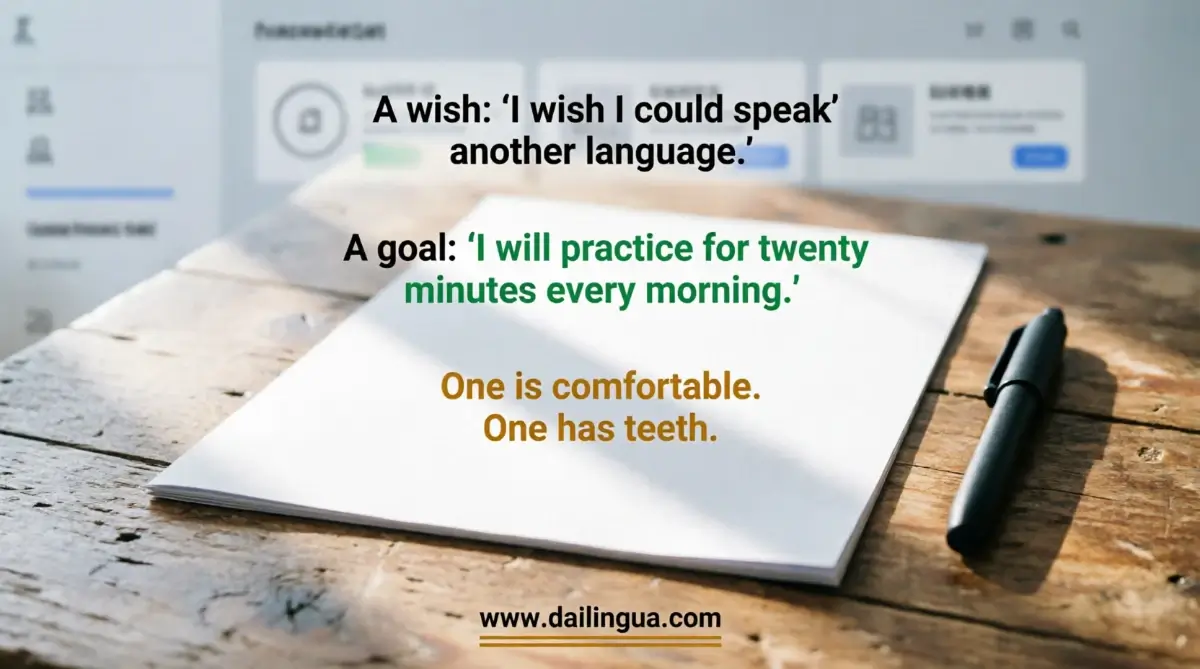
I used to confuse goals with wishes. A wish is a pleasant thought about a possible future. “I wish I could speak another language.” “I wish I were fluent.” Wishes are comforting because they require nothing of me in the present. They live in a hazy tomorrow that never quite arrives. I can wish for fluency for a decade and never take a single action toward it, and the wish will remain intact, undamaged by the reality of my inaction.
A goal is different a goal is a contract I make with myself, and it has terms. It specifies what I will do, when I will do it, and how I will know when I have done it. “I will practice speaking for twenty minutes every morning before work, and I will measure my progress by recording myself once a month and listening back.” That is not a wish. That is a commitment with teeth. It cannot be postponed without consequence. It cannot be held indefinitely in a future that never arrives. It lives in the present tense, and it demands present action.
The shift from wishing to goal-setting was one of the most important transitions of my entire language journey. It took the practice out of the realm of vague aspiration and into the realm of daily action. I was no longer hoping to learn a language someday. I was learning a language today, and I had the marks on my calendar to prove it. The shift did not happen all at once. I had to catch myself, again and again, framing my intentions as wishes and then rewriting them as goals. Over time, the habit of goal-setting replaced the habit of wishing, and the difference in my progress was unmistakable.
Why I Stopped Setting Goals Based on Other People’s Timelines
In the early months I would read stories of people who had reached conversational fluency in six months, or passed a proficiency exam after a year of study, and I would try to mold my own goals around those timelines. If they could do it in six months, I told myself, then that should be my target too. The logic felt sound: if the method worked for them, it would work for me. If the timeline was possible for them, it was possible for me.
The result was always the same I fell short of the unrealistic timeline, and the shortfall felt like failure. I had not considered that the other person might have more free time, or a different native language that made the target language easier, or access to resources I did not have, or simply a different natural pace of learning. I had taken their outcome and tried to wear it as my own expectation, and the fit was never right. The unrealistic timeline was a garment cut for someone else’s body, and I was constantly adjusting it, constantly feeling the seams pull against my own reality.
I stopped doing this I stopped reading the success stories as templates and started reading them as inspiration proof that it was possible, not blueprints for my own path. My timeline became my own, shaped by my available time, my purpose, my circumstances. The pressure lifted almost immediately. I was no longer racing against a stranger’s shadow. I was walking my own road, at my own pace, and the only person I needed to outpace was the version of myself who had woken up yesterday.
The Practice I Return to Every Time I Start a New Language
Every time I begin a new language and I have done this now with English, Turkish, Azerbaijani, and Russian I return to the same foundation. I audit my time. I clarify my purpose. I set a small, achievable daily goal. I track my consistency with a simple mark on a calendar. I record myself at the end of each month and listen back. I refuse to compare my progress to anyone else.
This process is not glamorous it does not photograph well for social media. There is no dramatic before-and-after to post, no sudden transformation to share. It is slow, deliberate, and deeply unphotogenic but it works. It has carried me through four languages and counting, and it has never once failed me when I have honored it. The beginner phase comes and goes sometimes quickly, sometimes slowly but it always ends. The only thing that can make it permanent is the belief that it already is and the lesson I learned about beginner language learning after working through multiple languages the core message was this: the beginner stage is not a life sentence. It is a season, and the length of that season is, more than anything else, a reflection of the goals I set and the honesty with which I set them the calendar does not lie. The chain does not pretend the marks on the page are the only evidence I need that I am moving forward, and forward is the only direction that matters.